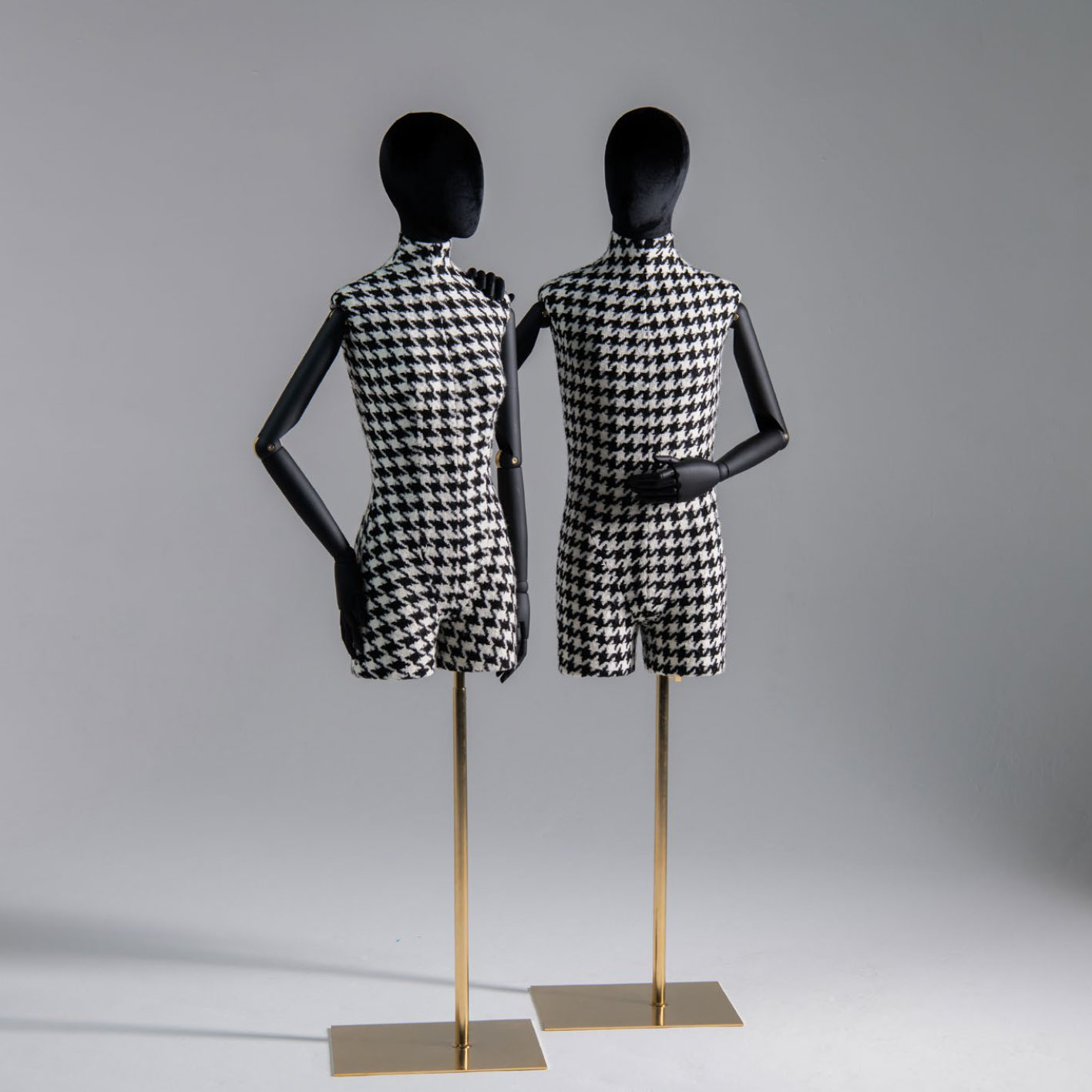
In 2026, the visual merchandising is no longer content to simply create desire. It must do so with meaning.
Retail is entering a new era where visual impact meets environmental impact, where creativity meets circularity, where every mannequin, every window display and every installation must tell a story that resonates.
For a long time, visual merchandising had a single objective: to seduce.
Creating desire. To catch the eye. Draw customers into the shop.
But by 2026, that's no longer enough.
The visual merchandising managers, the retail designers, the CSR managers that we meet all tell us the same thing: they no longer want to choose between beauty and responsibility. Between desirability and sustainability. Between creativity and circularity.
They want both. And they are right to demand it.
Here are the 5 major trends that will redefine visual merchandising in 2026.
1. Circularity as the new creative language of retail
For too long, «recycled» has been equated with «beautiful».
As if recycled material had to be dull. Less premium. A compromise.
This vision is outdated.
In 2026, the most innovative brands understand that circularity is not a creative brake. It's a language. A signature. A way of telling a unique story.
When recycled materials become aesthetic signatures
The recycled materials have textures. Irregularities. Nuances.
What was once seen as a flaw becomes a quality.
At IDW Paris, We're seeing VM directors who no longer want «perfect», generic models. They want surfaces that tell a story. Finishes that tell a story. Details that give character.
Circularity thus becomes an element of aesthetic differentiation. A way of creating a unique visual identity.
Because a mannequin made from bio-sourced or recycled materials will never have exactly the same texture as another. And that's precisely what makes it so precious.
2. Hyper-personalisation at the service of brand identity
Brands no longer want to look like everyone else.
In a world where the retail offer is saturated and competition is fierce, visual identity is becoming a key factor. major strategic challenge.
And that starts with the shop windows.
Made-to-measure, a requirement of modern retailing
A mannequin is no longer just a support.
He's a brand ambassador.
The directors visual merchandising we work with want models who embody their DNA. Not models who follow a generic trend.
That's why hyper-personalisation will be the norm in 2026:
- Tailor-made postures that reflect the energy of the brand
- Finishes that reflect the aesthetic universe of the collection
- Proportions adapted to the target morphology of customers
- Facial expressions that convey emotion and character
It's no longer a luxury. It's a necessity if you want to stand out from the crowd.
At IDW Paris, we co-create with brands to translate their identity into volume. Because a well-designed mannequin is a presence. Not a decoration.
3. Agile 3D: rapid prototyping, innovation without waste
Retail doesn't wait.
Collections come and go. Concepts evolve. Window displays are renewed at a steady pace.
And VMs need to be able to test, adjust and validate quickly.
This is where our 3D modelling changes everything.
How 3D modelling is revolutionising visual merchandising
Agile 3D makes it possible to :
- Rapid prototyping.
No need to wait weeks to see a first version. In just a few days, a 3D prototype can be used to visualise the posture, proportions and general appearance of the mannequin.
- Adjust without wasting.
Modify a posture, test a variation, adapt a proportion: everything is done digitally before manufacture. No wasted material. No unnecessary moulds.
- Confirm with precision.
The teams can see the mannequin from all angles, in different contexts and with different outfits. Validation is done with full knowledge of the facts.
This agility changes the game. It means we can innovate faster. To test bold ideas. To customise without blowing deadlines.
And it fits in perfectly with our responsible approach: we only produce what has been validated.
4. Experiential retailing: creating moments, not shop windows
Customers are no longer just buying a product.
They are buying an experience. An emotion. A moment.
And visual merchandising must support this transformation.
Customer experience at the heart of window design
In 2026, shop windows are no longer static.
They tell stories. They create atmospheres. They invite you in.
The mannequins are no longer simply clothes racks. They become characters. They carry an intention. They suggest a movement, a gesture, an energy.
The VM directors we work with now think in terms of scenography:
- What story do we want to tell?
- What emotion do we want to evoke?
- What moment do we want to create?
And to create these memorable moments, they need expressive mannequins. Postures that tell a story. Details that captivate.
It is this shift from product to experience that will redefine visual merchandising in 2026.
5. Transparency, the new standard for committed retail
- Customers want to know.
Where the products come from. How they are made. Who created them. What is their impact.
This demand for transparency now extends to visual merchandising.
- Promoting know-how and behind-the-scenes creative work
In 2026, the most committed brands will no longer be content to simply say «I'm a brand".« we are responsible« .
- They show.
- They showcase the craftsmen who sculpt the mannequins.
- They explain the manufacturing process.
- They reveal the materials used and their origin.
At IDW Paris, we believe that this transparency is a strength.
When a customer knows that a mannequin has been sculpted by European craftsmen, manufactured from recycled materials, designed to last 15 years, it changes the way he looks at things.
The mannequin is no longer an anonymous object. It becomes the bearer of a story. Of know-how. An intention.
And it is precisely this transparency that strengthens the credibility of committed brands.
Because in 2026, saying is no longer enough. You have to show. Prove it. Assume.
_______________
2026: the year visual merchandising reinvents itself
These 5 trends are not simply aesthetic developments.
They are redefining the very profession of visual merchandising manager, retail designer, CSR Manager.
Because in 2026, creating a showcase also means taking a stand.
At IDW Paris, we've been part of this transformation for 36 years. And we look forward to continuing to co-create tomorrow's retail with you.
In February, we will be presenting these innovations at EUROSHOP Düsseldorf. Come and discover how we translate these trends into concrete creations.
Do you have a visual merchandising project? Get in touch with us!